
People who search for helonium often land on confusing pages. Some sites call it a fictional element. Others treat it as a game card or a news brand. This mix of answers wastes time. It also spreads wrong science to students and curious readers.
This guide fixes that problem with clear, checked facts. It explains what helonium is, how it formed, and why it matters. It also shows how astronomers finally found it in space. Readers who like simple term meaning explainers will find every key point here in plain words.
What Is Helonium and Why Does the Name Confuse People?
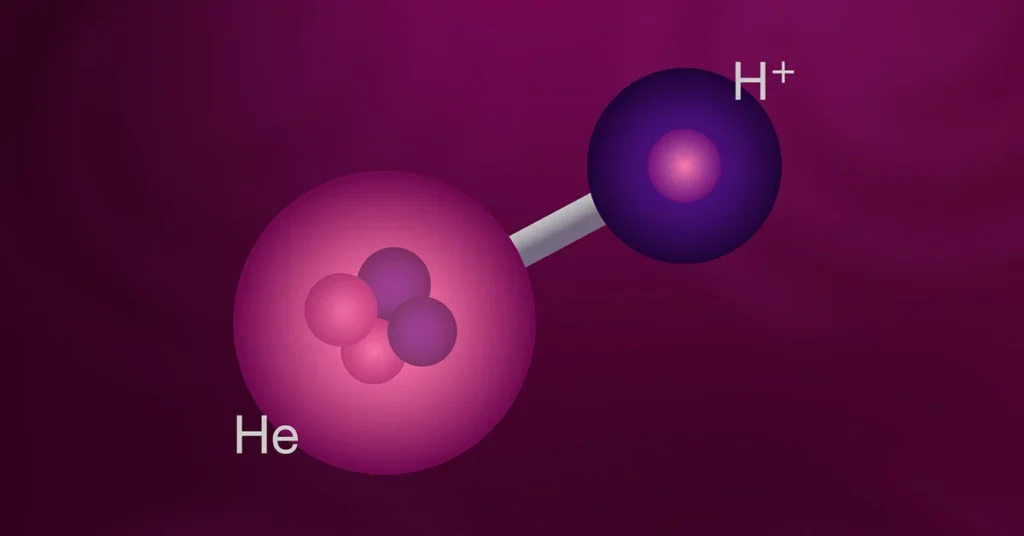
Helonium is the common name for the helium hydride ion. Its chemical formula is HeH⁺. The ion has one helium atom and one hydrogen atom, with a positive electric charge. It is a real, studied molecule. It is not a made-up element from a story.
The confusion starts with the name. It sounds like an element from the periodic table. That is not the case. Helonium is a charged molecule built from two real elements. Understanding this small difference clears up most of the wrong claims found online.
The Meaning Behind the Name
The word comes from “helium” plus the suffix “-onium.” Chemists use “-onium” for positively charged ions formed by adding a proton. Ammonium follows the same pattern. Argonium and neonium also follow it. So the name simply tells chemists how the ion is built.
Helonium Is an Ion, Not an Element
Elements sit on the periodic table, and helonium does not. It is a compound ion. Helium is the noble gas, and hydrogen is the lightest element. Together, with one electron removed, they form HeH⁺. Calling it an element is like calling water an element. Both are combinations.
Other Uses of the Word
The word also appears outside science. A mobile game uses it as a card name. A few websites use it as a brand. None of these uses describe the real ion. Readers who want the scientific meaning should look for “helium hydride ion” or “HeH⁺” to avoid mix-ups.
How Helonium Formed After the Big Bang
Scientists believe helonium was the first molecule ever made. The early universe held mostly hydrogen and helium. Nothing else existed in large amounts. When the cosmos cooled enough, these atoms could finally join. Helonium came from one of the earliest of these meetings.
The Max Planck Society explains that the young universe fell below roughly 4,000 kelvin. Then the light elements recombined in reverse order of their ionization potential. Helium gets ready first. That timing gave helium atoms a chance to meet bare protons.
The Cooling Universe
Right after the Big Bang, everything was too hot for bonds. Atoms kept losing electrons. As space expanded, temperatures dropped. Helium captured electrons earlier than hydrogen did. This left neutral helium and free protons floating together. That mix set the stage for the first chemical bond.
The Reaction That Made Helonium
A neutral helium atom met a free proton. They joined and released a little light. Scientists call this process radiative association. The result was HeH⁺. It was a fragile bond, but it was a bond. NASA describes it as the universe’s first molecular bond.
Why It Mattered for the First Stars
Helonium helped create the next molecule, which was hydrogen gas. Hydrogen gas helps clouds cool and collapse into stars. Astrobites notes that early-universe models needed this ion to form molecular hydrogen. So helonium acted as a stepping stone toward the first stars.
The Chemistry Behind Helonium
Chemically, helonium is unusual. Helium is a noble gas, and it normally avoids bonding. Yet it can hold a proton tightly in this ion. The result is a tiny, lightweight cation. Chemists call it the lightest heteronuclear ion because it has two different atoms.
This ion is also extremely reactive. It wants to hand its proton to almost anything it touches. Because of this, it cannot last in ordinary matters. That single trait explains why helonium is rare on Earth. It also explains why finding it in space took so long.
Structure and Size
The ion has just two atoms and three protons in total. One proton sits in the helium nucleus pair, and one in hydrogen. Its molar mass is about 5 grams per mole. That makes it one of the smallest molecular ions known. Its simple shape makes it a favorite for computer simulations.
The Strongest Known Acid
Wikipedia reports that HeH⁺ has a proton affinity of 177.8 kJ/mol and a pKa near −63. That ranks it as the strongest known acid. It beats even fluoroantimonic acid. In plain words, helium holds the proton very weakly. So the ion gives it away to almost any neutral molecule.
Why It Cannot Be Stored
Nobody can bottle helonium. Any container wall would react with it at once. Scientists make it in tiny amounts inside special vacuum machines. They study it for a few moments before it reacts. This is why stored samples or “helonium products” do not exist in real chemistry.
The Discovery of Helonium: From a 1925 Lab to Deep Space
The story of helonium has two big chapters. The first happened in a lab nearly a century ago. The second happened in 2019 in the night sky. Between them lay about 90 years of theory, hope, and failed searches.
This long gap makes the story special. Scientists knew the ion existed because they had made it. They also believed it filled space. Yet no telescope could confirm it. The missing proof even raised doubts about some models of the early universe.
The 1925 Laboratory Discovery
A paper summary on arXiv notes that Hogness and Lunn first detected the ion in 1925. They used mass spectroscopy on a discharge in hydrogen and helium gas. Their instrument showed a particle with a mass-to-charge ratio of five. That clue pointed to HeH⁺.
Decades of Searching
In the late 1970s, researchers proposed that helonium might exist in space. Planetary nebulae looked like good hunting grounds. Several teams searched for it. Some earlier hints appeared in low-resolution data. None gave a clear answer. The search lasted about three decades.
SOFIA and NGC 7027
The breakthrough came with the airborne observatory SOFIA. The team, led by Rolf Güsten, observed the nebula NGC 7027. It lies about 3,000 light-years away in Cygnus. The signal sits at a wavelength of 149.1 micrometers. Earth’s air blocked that light, so SOFIA flew very high. The results appeared in Nature in April 2019.
Why Helonium Matters Today
Today, helonium matters because it tests our story of cosmic history. Models of the early universe predicted this ion. Finding it in a nebula showed those chemical rules work in real space. That boosted confidence in how scientists describe the first chapters of cosmic chemistry.
It also helps researchers study nebulae. Helonium forms in thin zones where hot radiation meets gas. Measuring it reveals temperature and density in those regions. In this way, a fragile ion becomes a useful tool for modern astronomy.
Testing Early-Universe Models
Cosmologists build computer models of the first gas clouds. Those models contain dozens of reactions, including helonium’s creation and destruction. The 2019 detection helped confirm part of that reaction network. If the ion had been missing, scientists would have needed to rethink their rate numbers.
Cousins in the Noble Gas Family
Other noble gases form similar ions. Argonium (ArH⁺) was spotted in the Crab Nebula years earlier. Neonium, kryptonium, and xenonium are also known on paper. Helonium is the simplest of this family. Comparing these ions shows how noble gases behave under extreme space conditions.
Helonium on Earth
On Earth, helonium has little practical use. It appears only in labs and in simulation work. Researchers still study it to test quantum chemistry methods. Because the ion has few electrons, computers can calculate its behavior very accurately. Readers who enjoy this kind of discovery can browse more news and explainer stories on the site.
FAQs
What is helonium in simple words?
Helonium is a tiny, positively charged molecule made of one helium atom and one hydrogen atom. Scientists also call it the helium hydride ion. Its formula is HeH⁺. It is believed to be the first molecule that formed in the universe.
Is helonium a real element?
No. Helonium is not an element on the periodic table. It is a molecular ion built from two elements, helium and hydrogen. Some websites call it fictional, but science papers confirm that it is a real ion.
What is the chemical formula of helonium?
The formula is HeH⁺. The plus sign shows it has a positive charge. It forms when a helium atom bonds with a proton, or when helium and hydrogen react and lose one electron.
When was helonium discovered?
Scientists first made it in a laboratory in 1925. Astronomers first detected it in space in April 2019. That detection used the SOFIA airborne observatory and was published in the journal Nature.
Where was helonium found in space?
It was found in the planetary nebula NGC 7027. This nebula lies about 3,000 light-years from Earth in the constellation Cygnus. The signal appeared in far-infrared light at about 149 micrometers.
Why is helonium called the strongest acid?
It gives away its proton to almost any neutral molecule. Its pKa is around −63, according to chemistry references. That is far stronger than common lab acids. Because of this, it reacts instantly with most substances.
Can helonium exist on Earth?
It exists only for very short times in labs and special plasmas. It reacts with nearly everything. For that reason, nobody can store or sell it. Normal air and container walls would destroy it within moments.
Why is helonium important for the early universe?
It was one of the first molecules to form after the Big Bang. It helped create molecular hydrogen, which cools gas clouds. That cooling allowed the first stars to form. So helonium links early chemistry to star birth.
Conclusion
Helonium is a real and fascinating molecule, not a fictional element. It formed in the young universe, it is the strongest known acid, and it was finally confirmed in space in 2019. Its story connects a 1925 lab result with modern airborne astronomy and early cosmic chemistry.
Curious readers can keep exploring cosmic chemistry and similar science topics on this site. Share this guide with a student or a friend who wants clear facts about helonium. Then read more of our explainers to keep learning how the universe began.